
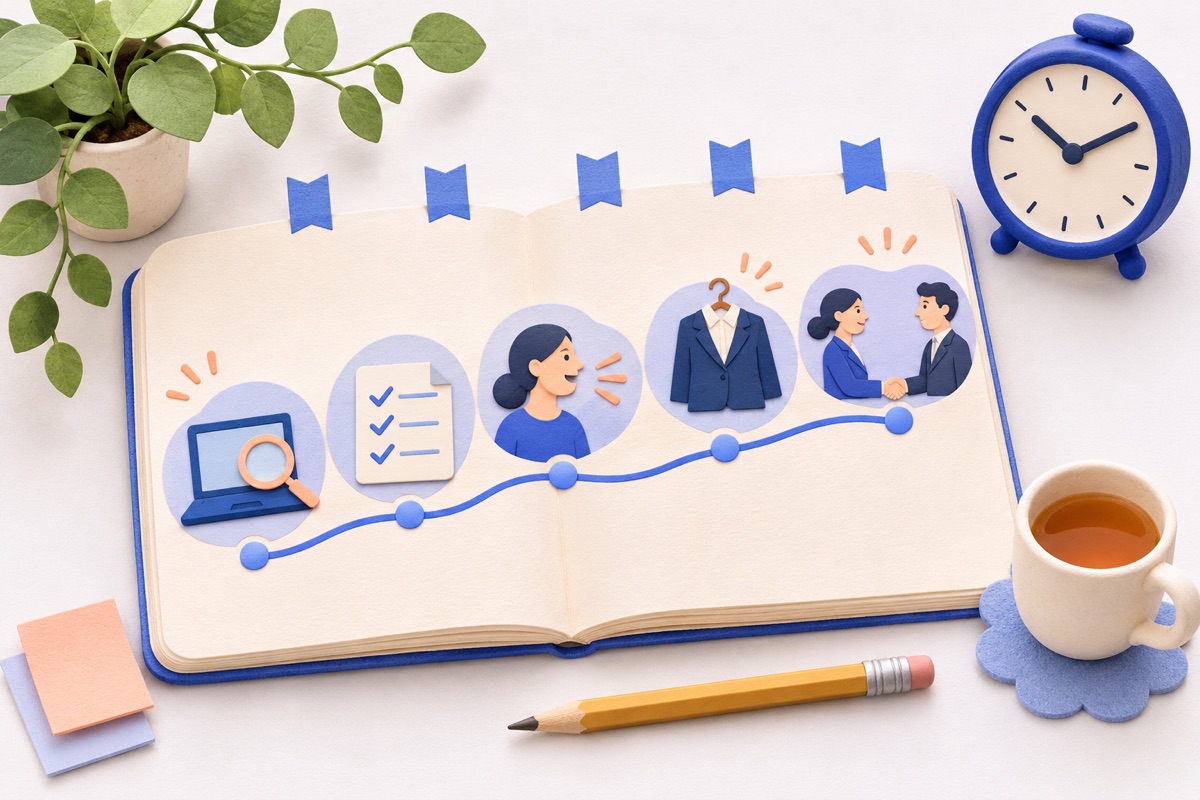
Your next step
Spend the time on the interview you actually have: format, relevant evidence, spoken practice, questions and logistics.
Start with a small, useful plan
LinkedIn’s January 2026 research reported that nearly 80% of people felt unprepared to find a job. That is about job-search confidence, not a measure of interview ability. See the research.
If you have an interview tomorrow, another hour of scrolling can leave you with more advice than preparation. This 60-minute plan is an editorial exercise, not a scientifically validated schedule. Adapt it to the stage and instructions you have received.
Minutes 0–10: confirm the interview
Read the invitation and job description. Write down the role, stage, time zone, location or meeting link, names provided and any requested preparation. Check whether there is an assessment, presentation or task with separate instructions.
For a video call, check your microphone, camera and meeting software. For an in-person meeting, plan the route and arrival time. If an important detail is missing, send one concise question to the recruiter.
Minutes 10–25: choose three real examples
Choose an example of solving a problem, working with another person and taking responsibility for a result. Adjust those themes to the actual role. Put four cues beside each: context, my action, outcome, lesson.
Keep the evidence accurate. You can explain a qualitative result if you do not have a reliable number. If the work is confidential, remove names and unnecessary details. Our skills-based interview guide has a simple mapping exercise.
Leave the first 25 minutes with a one-page brief
Make your research usable. Divide a sheet into four areas: what you know, what the role needs, your examples and your questions. Keep the actual invitation and employer instructions beside it.
| Area | Write down | Stop when… |
|---|---|---|
| Company and role | Three relevant facts from the current vacancy or official website; record the source | You can explain why the work interests you without reciting the company homepage |
| Likely responsibilities | Three tasks the person will actually do | Each task connects to a real example or an honest learning gap |
| Your evidence | Three story titles with context/action/result cues | You can retrieve the example without reading a paragraph |
| Your questions | Two or three things you need to understand | The answers would help you assess the role |
Separate a fact from a hypothesis. “The vacancy mentions onboarding new customers” is a fact you can point to. “They may be struggling with handovers” is an inference you could explore with a question. Do not turn it into an assertion about their business.
Minutes 25–40: rehearse out loud
Say your introduction and one example without reading a script. Use a phone recording, a trusted person or an interview-practice tool. Listen for whether the answer addresses the question and makes your contribution understandable.
Change one thing: shorten the setup, add a decision or explain the result. Then try a follow-up question. PrepPlease gives you voice practice with Mira and feedback afterward; your first interview includes up to three minutes free. Allow time to review the feedback rather than fitting in as many sessions as possible.
Minutes 40–50: prepare questions that help you decide
Pick questions whose answers are not already clear in the job description. For example:
- What would useful progress look like in the first few months?
- What is the main problem this person will help solve?
- How does the team make decisions when priorities conflict?
- What are the next steps after this conversation?
Choose the questions that fit the interview stage. You are also learning whether the work and expectations suit you.
Minutes 50–60: finish the practical details
Put the invitation, brief notes and any requested materials where you can find them. Charge your device, test audio and choose a quiet space where possible. Set your reminder and leave a buffer for travel or connection problems.
Then stop adding new material. Use your remaining time for ordinary rest and preparation that helps you arrive ready to listen. You do not need to rehearse a perfect response to every possible question.
After the interview, note the questions you found difficult while you remember them. Use those as the starting point for your next practice; they are more useful than trying to guess the interviewer’s final decision.
A useful opening answer, built from your own facts
For “tell me about yourself,” choose the experience most relevant to this role, one example of how you work and a concrete reason for this next step. You can rehearse a short version without trying to force a fixed duration.
Fictional example: project coordinator
“I work in operations, where I coordinate handovers between support and delivery. One project I enjoyed was making the escalation process easier for new colleagues to follow. I wrote the first guide, tested it with two teammates and revised the unclear steps. I’m interested in this coordinator role because it combines that kind of organization with more responsibility for planning across teams.”
The opening offers a relevant thread and a project the interviewer can explore. It does not list every job or claim expertise in all the responsibilities. Replace the example with your own facts, then practice the follow-up: “What exactly did you change in that process?”
Adapt the hour to the stage you actually have
The time blocks are a starting point. Shift your effort when the invitation gives you a specific task. If a deck, portfolio or assessment is required, allow time to prepare and test that material separately.
| Interview format | Focus your rehearsal on | Practical check |
|---|---|---|
| Recruiter conversation | Relevant background, reason for applying and questions about the process | Role details, timing and information the recruiter requested |
| Behavioral interview | A few real examples and the decisions behind them | Your contribution and outcome are easy to identify |
| Case or technical exercise | Understanding the problem and explaining your reasoning | Tools, instructions and allowed materials are clear |
| Sales role-play or demo | The confirmed task and supplied product/buyer facts | Time limit, participant roles and what you may assume |
| Recorded responses | Answering within the actual limits and following the rules | Practice mode, retakes, deadline and accessibility options if needed |
Harvard’s interviewing guide also distinguishes conversational, recorded, technical and case formats. Follow your own employer’s instructions; a general guide cannot establish what your particular round will contain.
Only 15 minutes? Use a smaller version
- Three minutes: check the time, link or location and the instructions. Fix an obvious access problem first.
- Four minutes: choose one relevant example and write context, action and outcome cues.
- Five minutes: say your introduction and that example out loud. Clarify one vague statement.
- Three minutes: choose two questions, put your notes in place and get ready to join.
This reduced plan is an editorial suggestion for a tight window. It does not replace a required task or make up for knowledge you have not yet developed. Use the time to organize what you already know.
Have a simple response for a difficult moment
You need a moment to think
Pause and say, “Let me choose an example that fits.” A brief pause gives you time to answer the actual question. If the question has several parts, ask which part the interviewer wants you to address first.
You do not know the exact answer
Say what you know, what you are unsure about and how you would check. In a technical or case discussion, explain assumptions before using them. For a past experience question, do not invent a story to fill the silence.
The call disconnects
Use the contact or backup method in the invitation. A short message can say you lost the connection and are trying to rejoin. Have the recruiter’s contact available before the interview so you do not need to search while the problem is happening.
Use five minutes afterward to capture useful evidence
Write down the questions you found difficult, the details the interviewer emphasized and any next steps they stated. Keep facts separate from your interpretation of their reactions.
- Observed: “They asked twice about my own contribution.”
- A useful practice task: “Make my decision and action clearer in that example.”
- Uncertain: “They probably disliked my answer.” Their expression does not establish the decision.
If a follow-up message is appropriate, keep it brief and specific to the conversation. Do not send extra material that was prohibited or confidential. Use the stated timeline to decide when to follow up.
Questions for the night before
Should I keep rehearsing until the answer is perfect?
Stop when you can explain the main point and respond to a follow-up without relying on exact wording. Another attempt is useful when it addresses a specific gap. Repeating the same paragraph indefinitely can use time you need for logistics, rest or a required task.
Can PrepPlease handle all of my interview preparation?
Use it for spoken interview practice, follow-up questions and feedback on your answers. Research the employer, check the actual instructions and prepare specialist tasks separately. Your free interview includes up to three minutes; additional practice is a one-time purchase.
Take the worksheet into your next practice
A practical takeaway
Your preparation, on one page.
Use the prompts to organize your own facts and plan the next attempt. Open the plain-text worksheet, then copy it into Notes or use your browser’s Save or Share controls. You can also print it.
Open the free worksheetNo signup. The website does not collect your answers. Keep sensitive details out of your notes.

Sources & editorial notes
The format and logistics advice above is consistent with Harvard’s interviewing guidance. The timed schedules and fictional opening answer are our own editorial examples.
- LinkedIn · Job-search and recruiting research · January 2026
- Harvard Mignone Center for Career Success · Interviewing
Sources checked 6 November 2026. Research provides context; the exercises are PrepPlease’s editorial guidance. Examples are illustrative. This guide is published by PrepPlease, which makes the app mentioned here. Illustrations generated with AI using PrepPlease’s original mascot as a reference.